EXPERIENCE RESEARCH + DESIGN
Deepening Gen Z Engagement at the Seattle Art Musuem

OVERVIEW
MY ROLE
UX Researcher & Designer
TEAMED UP WITH
1 UX Researcher
2 Product Designers
METHODOLOGY
User Interview
Shadowing
Literature Review
Trace Ethnography
DURATION
Jan – Jun 2026
OUTCOME
Presented at the Seattle Art Museum board, ongoing collaboration with the museum for potential future implementation
THE CHALLENGE
SAM wants to build a stronger relationship with Gen Z, but there aren't many of them in the museum…
Why don't Gen Z visitors (age 18-29) frequent the museum?
The membership numbers at the Seattle Art Museum have been declining for the past 10-15 years, and Gen Z is a big missing piece.
Gen Z is the future for museums, but how do we get them to become more active and frequent in the Seattle Art Museum?


HOW DO WE DEFINE ENGAGEMENT?

RESEARCH OVERVIEW
Our research focused on understanding how Gen Z engages with museums today and the pain points:
How do Gen Z currently experience artworks and galleries at SAM?
What motivates Gen Z visitors to go to museums in general, and what brings them specifically to SAM?

Build foundational understanding and explore directions, understand how technology is currently being used in the field of art museums

Understand the environment and natural visitor behaviors in the museum

Further uncover motivations, emotions, and underlying needs
→ Conducted 7 interviews in the museum to learn about visitors and validate assumptions from pervious research methods
We started off with understanding current visitor experiences, how technology is being used generally in museums around the world.
Through secondary research, we built our foundational knowledge to observe natural visitor behaviors at the Seattle Art Museum, and built hypothesis based on the field observation.
Using our observation notes to come up with our initial assumptions, we then crafted questions and recruited 7 participants at the museum lobby (people who are already motivated to visit and decided to buy tickets) to conduct shadowing and interview to further understand and validate assumptions.

FIELD OBSERVATION

RESEARCH INSIGHT #1
Experiencing art can be a shared, collaborative activity among friends, where meaning making is through jokes and shared memories.
OBSERVATION
Museum visits are inherently social moments where people connect using arts as backdrops ; resonance triggers information seeking and visit intent determines depths
INTERVIEW
"We can get creative in a different (way), build off of other people's creativity, which is just like a fun thing. I can talk to other people about art. It'll be a cool callback eventually as we explore more of this stuff.”- P2 @SAM
“It's not as much about the education that it is. It's more about the company.” - P1 @SAM
RESEARCH INSIGHT #2
Gen Z engages most when museum interactions feel reciprocal & produce something they can take away or share.
OBSERVATION
Photo-taking is often about identity expression, capturing shared moments, connecting oneself to the artwork, and the sharable experience they build around.
INTERVIEW
"I was in this museum in DC.. They had an interactive airplane exhibit. They showed you different ways to make paper airplanes, me and my friends had a huge competition, and we made it a big thing. It was fun. A good bit of time." - P2 @SAM
RESEARCH INSIGHT #3
Labels are used socially and briefly.
INTERVIEW
Visitors read labels briefly to protect their attention for the artwork
"Eventually the excitement dies a little bit because there's so much to take in.. I was reading so much, and I was like, wait (now) I'm not paying attention to the details of the art itself" - P6 @SAAM
Reading a label often becomes a shared activity.
"He'll question the art, and I'll be like, 'Well, they have the whole explanation on here.' So that's how I end up reading it and tell him." - P3 @SAM
OBSERVATION
“Art champions" within groups actively try to spark engagement, looking at labels and encouraging others to interact with artworks.
MORE RESEARCH & DISCOVERY, BUT VERY FUN
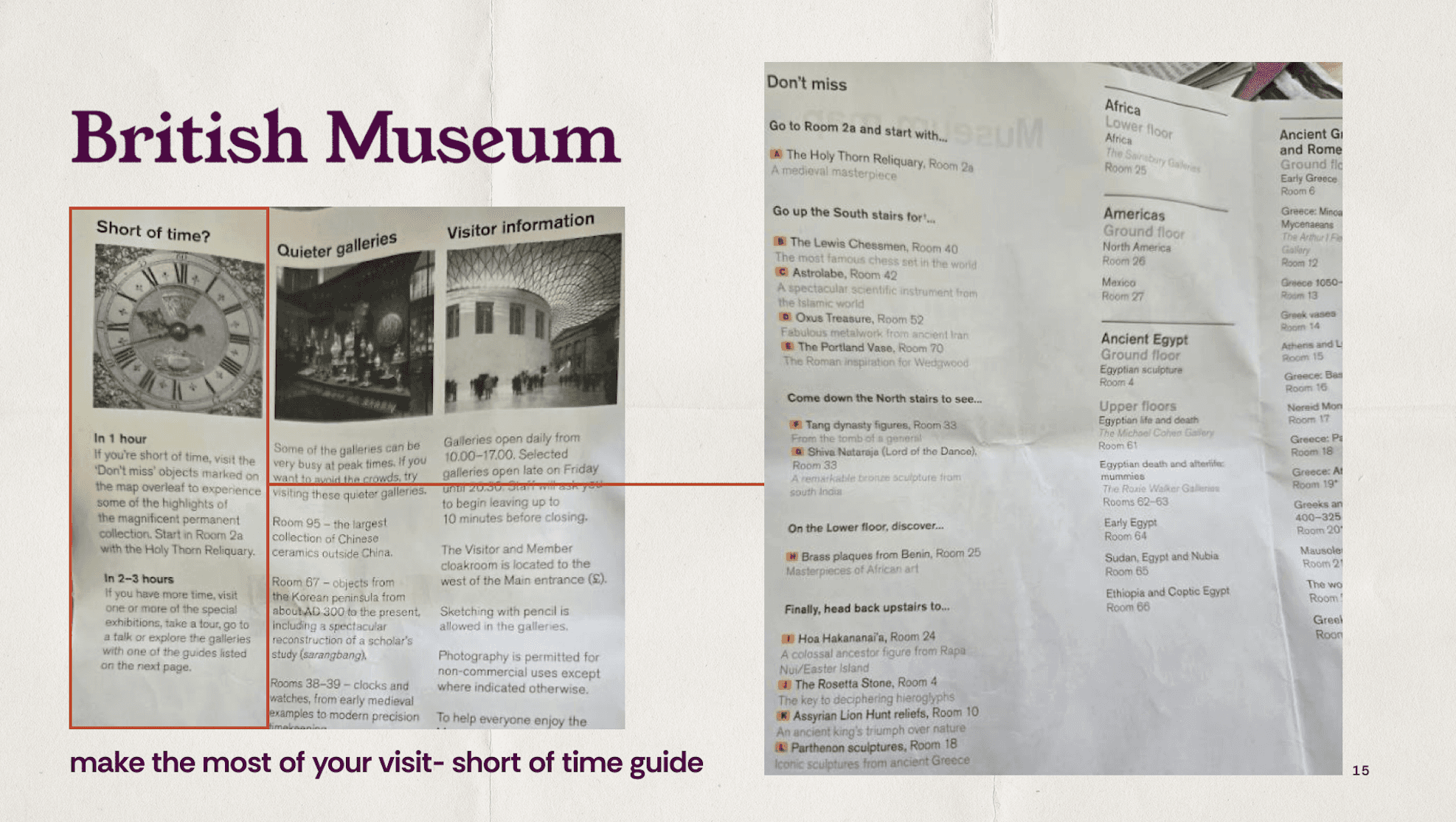
After we wrapped up the research, I had the opportunity to explore 12 museums in London on my own during my Spring break trip (had the time of my life, and yes even made a Figma slide for it..)
Some takeaways from the museums that were very engaging:
Good storytelling invites and immerses you in the story, rather than talking about a distant past that isn't relatable, making you feel like you were there, hits differently.
Short, simple, eye-catching questions prompt curiosity and make you want to think, know more, or look for answers in the room.
Interactive experiences that let people tailor the amount of information help immerse the audience in the artwork on their own terms and pace.
Good navigation plays a big part in a good museum visiting experience.




APPLYING RESEARCH TO DESIGN
SAM is currently being perceived as quiet, formal, and upscale. Most exhibits favor passive viewing, offering visitors little chance to interact socially, or leave with something they made.
Our research also led us thinking how the museum in different phases (like a blueprint) was, or could be like, and how this aligns with the Seattle Art Museum's goal of making this a welcoming and explorative social space, as well as prompted us to think about the relationship between a visitor and the artwork.
Past
Elitist with a higher entry barrier
Present
Fragmented engagement with information overload
Tomorrow
A fluid, socially driven space for co-creating personal, lasting meaning
I learned from my own field observation in London that "storytelling" and "present information in a way to spark curiosity " are critical in enhancing museum engagement, and this align closely with our research, that these listed elements are most crucial behind deeper engagement:
This later helped us came up with our design question and our design principles.
Interactive
Sharability
Storytelling
Social Dynamics
Identity Expression
Curiosity Extension
Personal Connection

How might we design socially engaging, shareable museum experience for Gen Z groups that deepen their personal connection to art and motivate them to return?
DESIGN PRINCIPLE
Based on our research findings, we prioritized the following five principles in designing the solution. Since social dynamics played a key role throughout the research, we also chose to focus on designing for groups rather than individuals.
01 Preserve the visitor’s attention with the artwork and presence in the space.
02 Design for experience worth carrying forward
03 Design for the group, not just the individual
04 Design for mutual interaction, not one-way delivery
05 Design for curiosity, not completion
RESEARCH TO DESIGN PROCESS

DESIGN BRAINSTORMING
We began by brainstorming individually before sharing, critiquing, and building on one another’s ideas to converge on several potential directions.

FILTERING IDEAS
We ran a workshop to define our evaluation criteria and assess all ideas, helping us identify the concepts that best aligned with our findings and design principles.

REFINING IDEATION
Through multiple rounds of divergence and convergence- lots of ideas crossed and getting stuck not sure how to merge all those great ideas from everyone- we decided to use journey mapping to help us clear up a new path, design a journey, then moving and stitching ideas together in different part of the museum journey, then decide whether they fit the story.

USER FLOW EXPLORATION AND TESTING
By this time, we were debating on the idea of a social experience with gamification, but we were not sure if people would be willing to go through it. So I ran a few light test and feedback sessions before we settled on a final solution, and learned that users are more likely to be motivated to go through a experience if they know they have something to takeaway in the end.

We then refined our ideas and arrived at the final conclusion- a social game experience with some twists and enhancements based on feedback.

FINAL STORYBOARD/PROTOTYPE
I was in charge of sketching the final storyboard of the game experience.

THE SOLUTION

SOLUTION
Concept video (with prototype demo)
How the experience looks like
The role of AI in this project has been a recurring topic from start. AI was used for generating recommendations at start and personalized items in the end (like a wrap of the journey) based on preferences visitors input, and the data collected throughout the game experience.

Behind the visitor experience

DESIGN GUIDELINES
To design the entire experience, we established specific guidelines for the game experience:
FUTURE IMPLEMENTATION
Currently, we are having an ongoing conversation with SAM to work on possible future implementation.
REFLECTION
As an art lover and frequent museum goer, working with art museum is honestly my dream job! It was exciting to get to explore museum experience in UX context and work on research and design in collaboration with the Seattle Art Museum. With the problem being very open-ended and no previous data from the museum, it required a lot of back-and-forth iteration of my own research and design process, as well as pushing through the ambiguity to define what does engagement mean to us and the stakeholders, a lot of communication to align on the goals, and apply the things we see fit to the design. I am beyond grateful to work on this project with so many people, I had so much fun, it was very challenging yet rewarding!


At the final showcase with my teammates and our clients from Seattle Art Museum!
back to top