SERVICE DESIGN
SERVICE DESIGN
Designing an Empathetic Path to Connection for Introverts
Designing an Empathetic Path to Connection for Introverts
Designing an Empathetic Path to Connection for Introverts
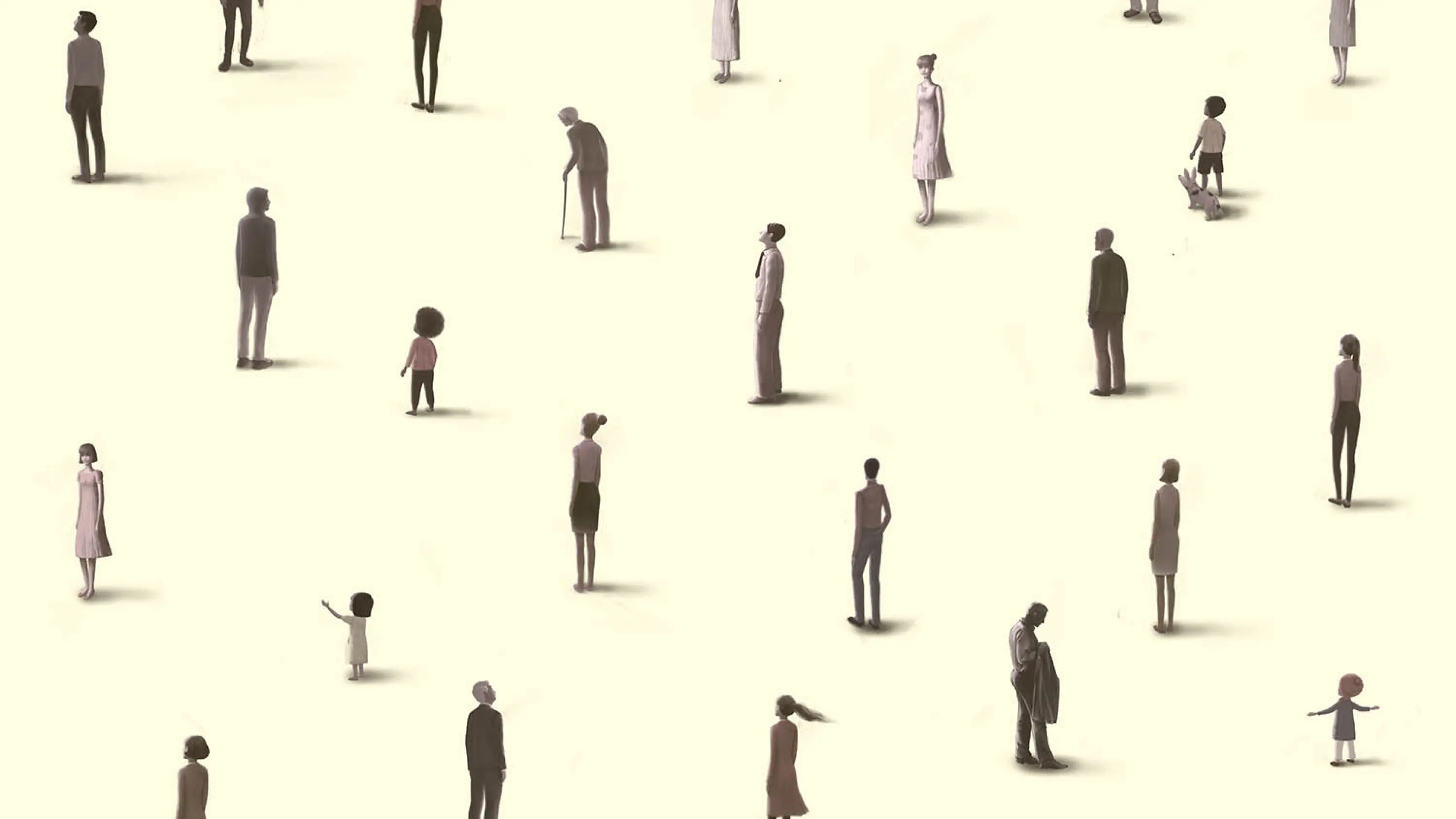
Living in Seattle, most of us realized how the ”Seattle Freeze“ makes forming social connection even more difficult. Although there are many solutions for social connection, it has struck us how most of them are high-energy format that tailored for extroverted norms, and the society has tend to view introverts as those "who probably don't suffer from social loneliness because they enjoy being alone".
Our goal is to understand how social infrastructures can support people with different forms of engagement to build social connections, we intentionally included scaffolded friction into our community service design to support user growth and autonomy in social participation through return visits. We want to empower users to tailor their preferences and make their own decisions about how and when they participate in social interactions.
Living in Seattle, most of us realized how the ”Seattle Freeze“ makes forming social connection even more difficult. Although there are many solutions for social connection, it has struck us how most of them are high-energy format that tailored for extroverted norms, and the society has tend to view introverts as those "who probably don't suffer from social loneliness because they enjoy being alone".
Our goal is to understand how social infrastructures can support people with different forms of engagement to build social connections, we intentionally included scaffolded friction into our community service design to support user growth and autonomy in social participation through return visits. We want to empower users to tailor their preferences and make their own decisions about how and when they participate in social interactions.
MY ROLE
UX Researcher
Service Designer
Co-Design Moderator
TEAM
3 UX Researchers
1 Product Designer
METHODOLOGY
Literature Review
Digital Ethnography
User Interview
Participatory Research
Narrative Prototyping
DURATION
9 Weeks
Jan – Mar 2026
THE PROBLEM
THE PROBLEM
No man is an island?
The epidemic of loneliness
No man is an island?
The epidemic of loneliness
No man is an island?
The epidemic of loneliness
Loneliness is increasingly recognized as a public health crisis
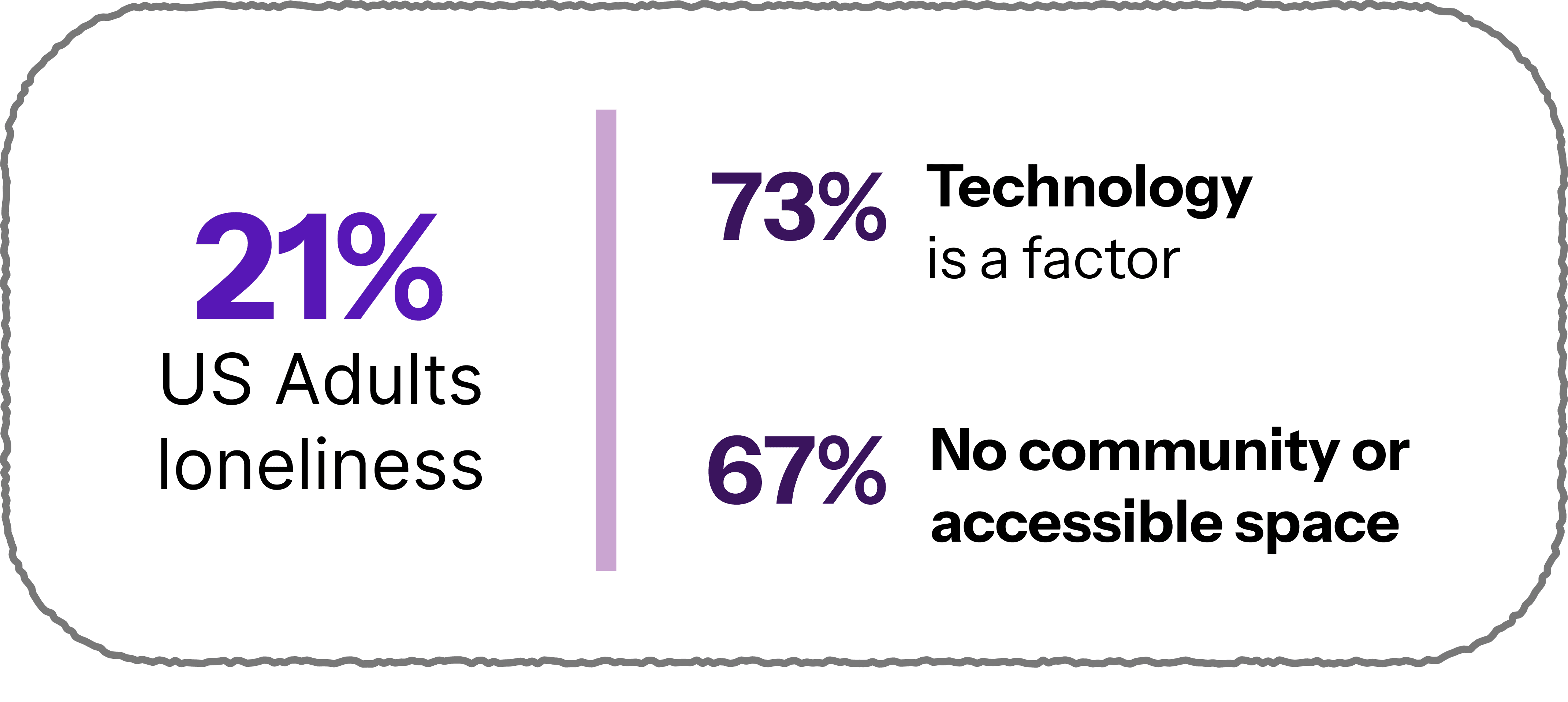
A Harvard study found that 21% of adults in the U.S. experience loneliness, and 67% lack meaningful communities. Many people call for more events, more public spaces, and more opportunities to connect. And the prevailing belief is that more social activity will reduce loneliness.
Loneliness is increasingly recognized as a public health crisis
A Harvard study found that 21% of adults in the U.S. experience loneliness, and 67% lack meaningful communities. Many people call for more events, more public spaces, and more opportunities to connect. And the prevailing belief is that more social activity will reduce loneliness.
But most solutions are program-based and engagement-heavy
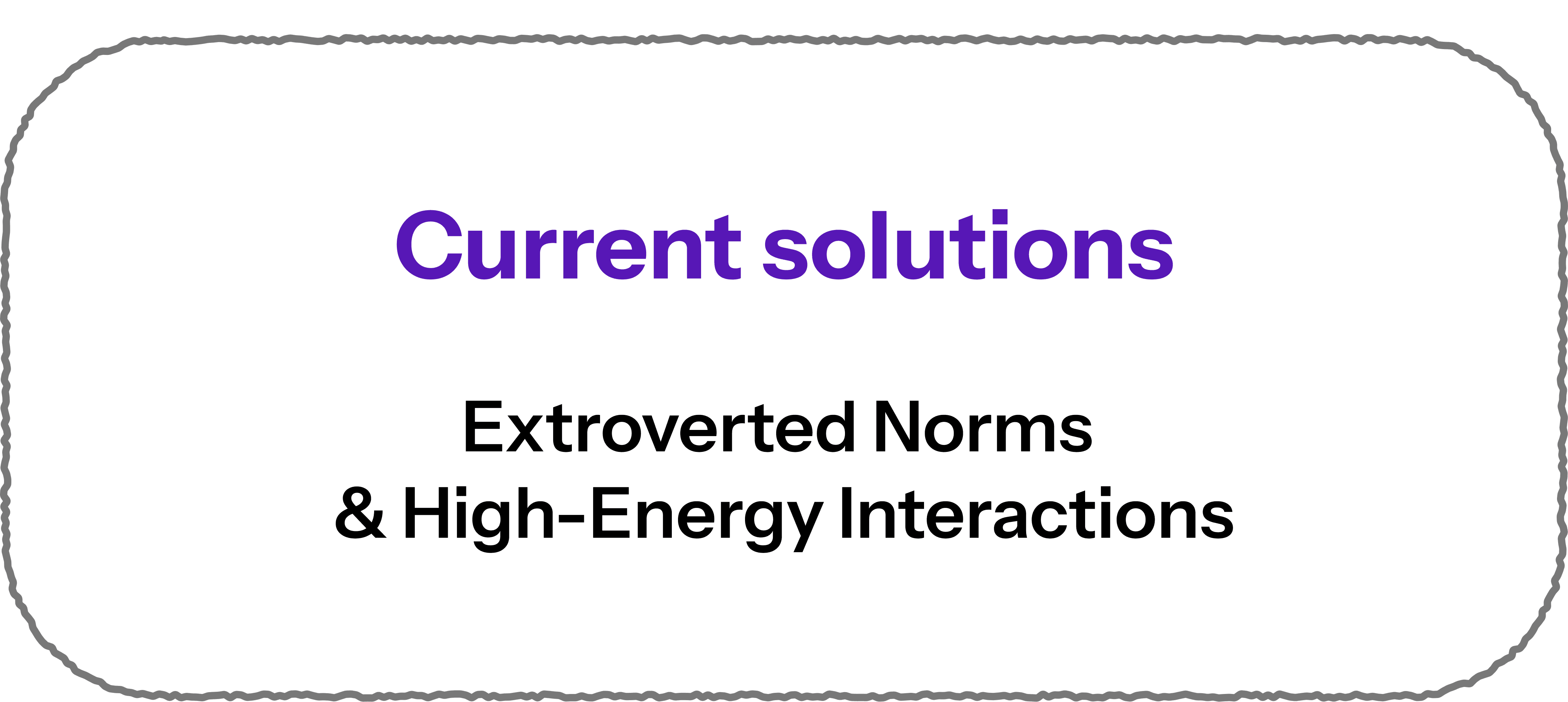
Existing solutions overlook introverted individuals who care deeply about connection but experience social interaction differently, social connection happens through high-energy interaction, spontaneous conversation, and active participation is a general belief. These environments create higher friction entry, and often reward extroverted behaviors.
As a result, people who process stimulation differently may feel pressure rather than belonging, such as introverted people.
But most solutions are program-based and engagement-heavy
Existing solutions overlook introverted individuals who care deeply about connection but experience social interaction differently, social connection happens through high-energy interaction, spontaneous conversation, and active participation is a general belief. These environments create higher friction entry, and often reward extroverted behaviors.
As a result, people who process stimulation differently may feel pressure rather than belonging, such as introverted people.
REFRAMING
REFRAMING
What if the issue isn’t willingness to connect,
but how connection is designed?
What if the issue isn’t willingness to connect,
but how connection is designed?
What if the issue isn’t willingness to connect, but how connection is designed?
What if social spaces unintentionally demand performance instead of authenticity? Instead of asking people to adapt to high-pressure formats, what if we adapted the format to different emotional processing systems? Existing solutions overlook introverted individuals who care deeply about connection but experience social interaction differently.
Rather than asking people to adapt to conversation-driven formats, we questioned: could the format itself better accommodates different ways of engaging socially? This question reframed how we approached loneliness, and led us beyond individual behavior to examine the role social infrastructure plays in shaping community interaction.
What if social spaces unintentionally demand performance instead of authenticity? Instead of asking people to adapt to high-pressure formats, what if we adapted the format to different emotional processing systems? Existing solutions overlook introverted individuals who care deeply about connection but experience social interaction differently.
Rather than asking people to adapt to conversation-driven formats, we questioned: could the format itself better accommodates different ways of engaging socially? This question reframed how we approached loneliness, and led us beyond individual behavior to examine the role social infrastructure plays in shaping community interaction.
RESEARCH QUESTION
RESEARCH QUESTION
How can social infrastructure better support meaningful connection for individuals who find traditional social interactions draining?
How can social infrastructure better support meaningful connection for individuals who find traditional social interactions draining?
CORE RESEARCH INSIGHTS
CORE RESEARCH INSIGHTS
Activity-based environments and shared tasks reduce social pressure, allowing connection to emerge organically rather than being explicitly demanded.
Desire for meaningful participation with tangible accomplishment from social spaces.
Autonomy and agency in a non-judgmental social environment are strongly valued.
In the context of growth, there must be a balance between lower friction for entry and higher friction for ongoing participation.
AI has been more actively used in social context as a form of emotional support and companion
Activity-based environments and shared tasks reduce social pressure, allowing connection to emerge organically rather than being explicitly demanded.
Desire for meaningful participation with tangible accomplishment from social spaces.
Autonomy and agency in a non-judgmental social environment are strongly valued.
In the context of growth, there must be a balance between lower friction for entry and higher friction for ongoing participation.
AI has been more actively used in social context as a form of emotional support and companion
RESEARCH & DESIGN PROCESS
RESEARCH & DESIGN PROCESS
How we validate problem and understand users through different methodologies
How we validate problem and understand users through different methodologies
How we validate problem and understand users through different methodologies
Overall, people experience performance exhaustion from maintaining social norms that requires significant recovery time afterwards. There's also a strong need to normalize vulnerability and to recognize that introverts often feel pressured, overlooked, or compelled to over-please in social settings. Shared experiences over traditional "getting to know you" conversations are preferred by them, as familiarity and predictability reduce cognitive load.
Overall, people experience performance exhaustion from maintaining social norms that requires significant recovery time afterwards. There's also a strong need to normalize vulnerability and to recognize that introverts often feel pressured, overlooked, or compelled to over-please in social settings. Shared experiences over traditional "getting to know you" conversations are preferred by them, as familiarity and predictability reduce cognitive load.
LITERATURE REVIEW
Validated the problem space by reviewing existing landscape to confirm initial assumptions:
Structural bias in existing interventions:
Existing interventions are predominantly designed around extroverted modes of engagement, conversation-based activities that creates a structural disadvantage for introverts.Tension between low-friction entry & meaningful civic engagement
While low-barrier designs increase participation, overly frictionless systems risk producing passive consumer engagement rather than genuine connection.Misattribution of introvert social needs
Introversion has historically been associated with lesser need for social connection, particularly reinforced during COVID-19. Research validates that introverted individuals are in fact particularly sensitive to lack of social support and disconnection.Cognitive and perceptual differences in social processing
Introverted individuals process social cues and rejection fears differently. Effective social infrastructure must account for these differences by reducing perceived social risk and pressure rather than demanding forward, bold participation.
LITERATURE REVIEW
Validated the problem space by reviewing existing landscape to confirm initial assumptions:
Structural bias in existing interventions:
Existing interventions are predominantly designed around extroverted modes of engagement, conversation-based activities that creates a structural disadvantage for introverts.Tension between low-friction entry & meaningful civic engagement
While low-barrier designs increase participation, overly frictionless systems risk producing passive consumer engagement rather than genuine connection.Misattribution of introvert social needs
Introversion has historically been associated with lesser need for social connection, particularly reinforced during COVID-19. Research validates that introverted individuals are in fact particularly sensitive to lack of social support and disconnection.Cognitive and perceptual differences in social processing
Introverted individuals process social cues and rejection fears differently. Effective social infrastructure must account for these differences by reducing perceived social risk and pressure rather than demanding forward, bold participation.
USER INTERVIEW & DIGITAL ETHNOGRAPHY
n=5 (4 Introverts + 1 Ambivert)
We then conducted 5 semi-structured user interviews with participants age between 18-45 to understand the current social connection experience and expectations of individuals who are more introverted.
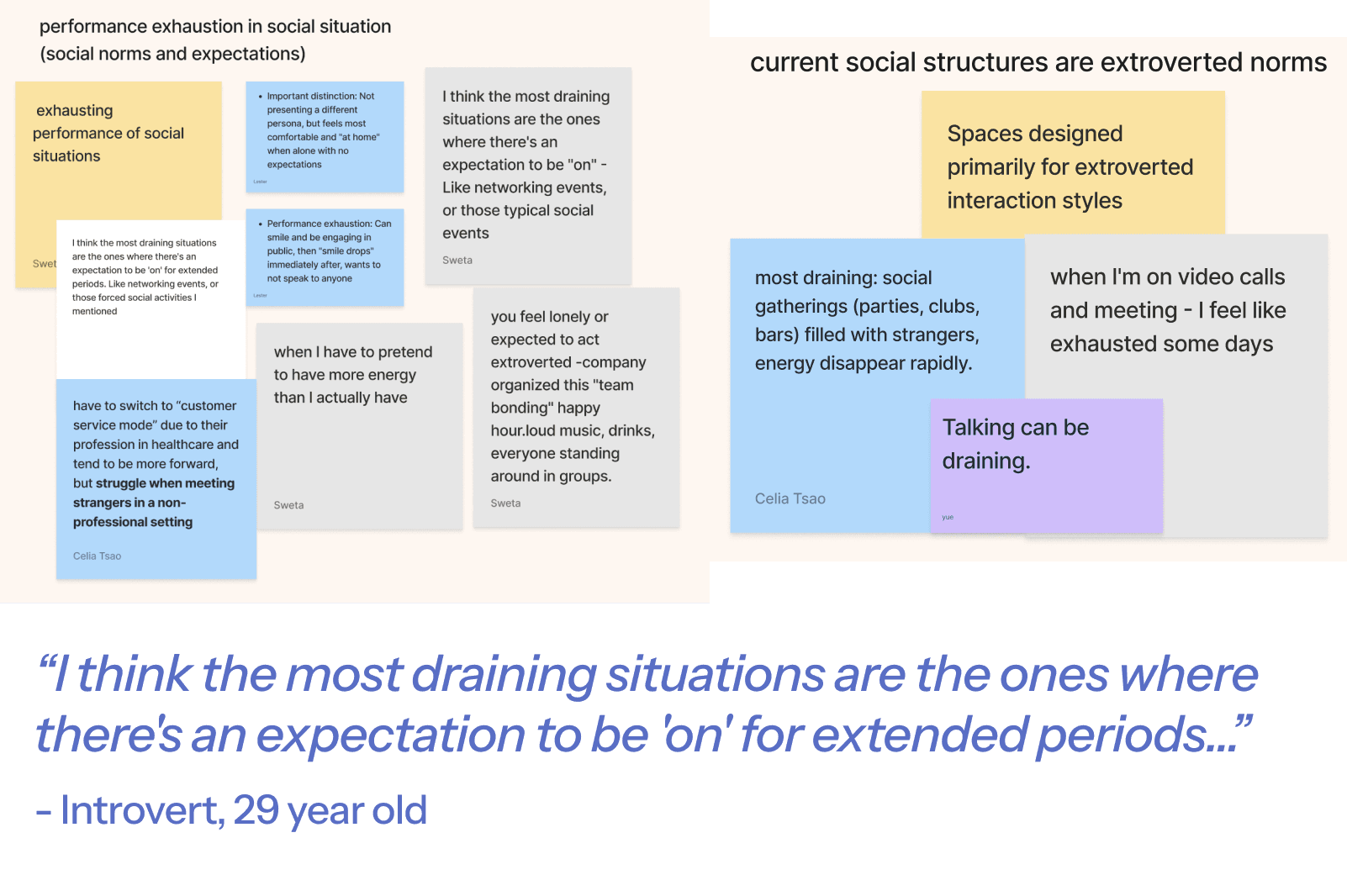
At the same time, ethnography research on Reddit, Facebook, Youtube helped us learn more about what people in the same age range actually talked about when navigating social loneliness and social spaces as introverts.
We noticed there were some recurring findings in these two primary research:
Activity-based environments and shared tasks reduce social pressure and allow connection to develop naturally.
Prefer low-stakes environments to be around others without forced interaction.
The need for non-verbal connections
Current infrastructure favors extroverts and makes introverts feel pressured and left out
Ideal social spaces should be accommodating to diverse social energy needs with solo space and recess options
USER INTERVIEW & DIGITAL ETHNOGRAPHY
n=5 (4 Introverts + 1 Ambivert)
We then conducted 5 semi-structured user interviews with participants age between 18-45 to understand the current social connection experience and expectations of individuals who are more introverted.At the same time, ethnography research on Reddit, Facebook, Youtube helped us learn more about what people in the same age range actually talked about when navigating social loneliness and social spaces as introverts. We noticed there were some recurring findings in these two primary research:Activity-based environments and shared tasks reduce social pressure and allow connection to develop naturally.Prefer low-stakes environments to be around others without forced interaction.The need for non-verbal connectionsCurrent infrastructure favors extroverts and makes introverts feel pressured and left outIdeal social spaces should be accommodating to diverse social energy needs with solo space and recess options
PARTICIPATORY RESEARCH (CO-DESIGN)
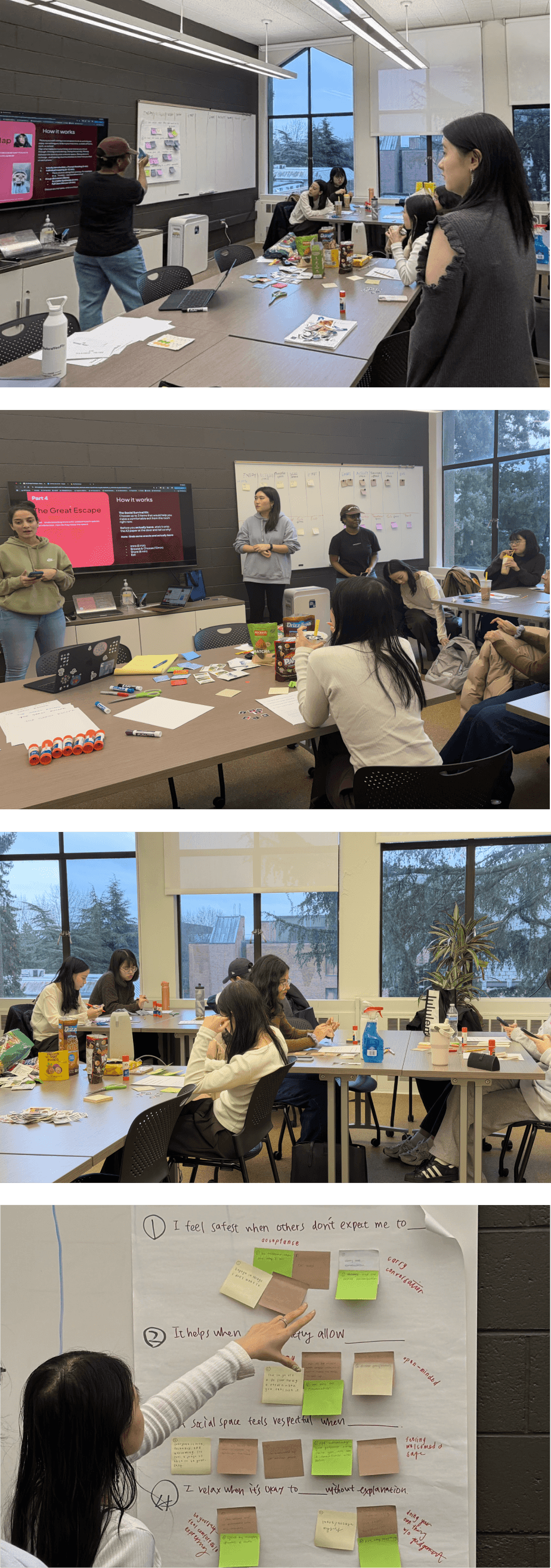
To guide and uncover our target users' own unmet needs and unrealized desires that can be later used as our design drivers, we led an in-person co-design workshop with 7 participants (6 introverts, 1 extrovert) exploring: ideal social spaces, shared values around unspoken rules, social friction points, and graceful exit strategies with activities below:
Ideal Space Collage
To identify tangible and sensory cues that can make a shared space feel comfortable and secure
Invisible Agreements
To identify shared values around co-presence, emotional safety, social connectedness.
The Emo Map
To identify emotional friction points and user patterns in navigating social spaces.
The Great Escape
To understand introverts' preferences in spaces, interactions, and leaving social spaces
Key insights
Need for tangible accomplishment from social spaces rather than simply spending time there
Autonomy and agency in social engagement are valued to enter and exit conversations freely without expectationsImplicit over explicit communication helps people avoid the discomfort of explicitly ending social interactions
Respectful and non-judgmental social culture is critical for them to feel comfortable expressing themselves
Appreciation of non-human companionship were pictured in their ideal spaces such as plants and animals to provide comfort and reduce social pressure in shared environments.
PARTICIPATORY RESEARCH (CO-DESIGN)
To guide and uncover our target users' own unmet needs and unrealized desires that can be later used as our design drivers, we led an in-person co-design workshop with 7 participants (6 introverts, 1 extrovert) exploring: ideal social spaces, shared values around unspoken rules, social friction points, and graceful exit strategies with activities below:
Ideal Space Collage
To identify tangible and sensory cues that can make a shared space feel comfortable and secure
Invisible Agreements
To identify shared values around co-presence, emotional safety, social connectedness.
The Emo Map
To identify emotional friction points and user patterns in navigating social spaces.
The Great Escape
To understand introverts' preferences in spaces, interactions, and leaving social spaces
Key insights
Need for tangible accomplishment from social spaces rather than simply spending time there
Autonomy and agency in social engagement are valued to enter and exit conversations freely without expectationsImplicit over explicit communication helps people avoid the discomfort of explicitly ending social interactions
Respectful and non-judgmental social culture is critical for them to feel comfortable expressing themselves
Appreciation of non-human companionship were pictured in their ideal spaces such as plants and animals to provide comfort and reduce social pressure in shared environments.
PARTICIPATORY RESEARCH (CO-DESIGN)
To guide and uncover our target users' own unmet needs and unrealized desires that can be later used as our design drivers, we led an in-person co-design workshop with 7 participants (6 introverts, 1 extrovert) exploring: ideal social spaces, shared values around unspoken rules, social friction points, and graceful exit strategies with activities below:
Ideal Space Collage
To identify tangible and sensory cues that can make a shared space feel comfortable and secure
Invisible Agreements
To identify shared values around co-presence, emotional safety, social connectedness.
The Emo Map
To identify emotional friction points and user patterns in navigating social spaces.
The Great Escape
To understand introverts' preferences in spaces, interactions, and leaving social spaces
Key insights
Need for tangible accomplishment from social spaces rather than simply spending time there
Autonomy and agency in social engagement are valued to enter and exit conversations freely without expectationsImplicit over explicit communication helps people avoid the discomfort of explicitly ending social interactions
Respectful and non-judgmental social culture is critical for them to feel comfortable expressing themselves
Appreciation of non-human companionship were pictured in their ideal spaces such as plants and animals to provide comfort and reduce social pressure in shared environments.
The biggest challenge: mapping the ambiguity
The biggest challenge: mapping the ambiguity
The biggest challenge: mapping the ambiguity
One of the core steps in service design was ecosystem mapping, to identify the underlying needs, phase-specific needs, interactions, and touch points, map out the user journey, and then move on to service blueprint to define front-stage and back-stage, to further discover opportunities.
However, since the scope of a service could be pretty big and vague at early stage, ecosystem mapping at this point did not work for our case, especially we were designing something that was not based on an existing system or established community and resources, we found that things we put into our initial ecosystem were all over the place and some of them were not cohesive or making any sense to connect with each other.
So we decided to pivot: move on to journey mapping first, then do narrative prototyping to fill in the meat. After learning what could be appeared in the service by putting ourselves into users shoes in an empathetic lens, we came back with much clearer vision of what elements our service ecosystem contained. This was the most challenging part of our research and design process, lots of back-and-forth iterations between research and design, but this was also the part where we had the most fun and reflective moments.
Keep scrolling to see the process break downs!
One of the core steps in service design was ecosystem mapping, to identify the underlying needs, phase-specific needs, interactions, and touch points, map out the user journey, and then move on to service blueprint to define front-stage and back-stage, to further discover opportunities.
However, since the scope of a service could be pretty big and vague at early stage, ecosystem mapping at this point did not work for our case, especially we were designing something that was not based on an existing system or established community and resources, we found that things we put into our initial ecosystem were all over the place and some of them were not cohesive or making any sense to connect with each other.
So we decided to pivot: move on to journey mapping first, then do narrative prototyping to fill in the meat. After learning what could be appeared in the service by putting ourselves into users shoes in an empathetic lens, we came back with much clearer vision of what elements our service ecosystem contained. This was the most challenging part of our research and design process, lots of back-and-forth iterations between research and design, but this was also the part where we had the most fun and reflective moments.
Keep scrolling to see the process break downs!
ECOSYSTEM MAPPING
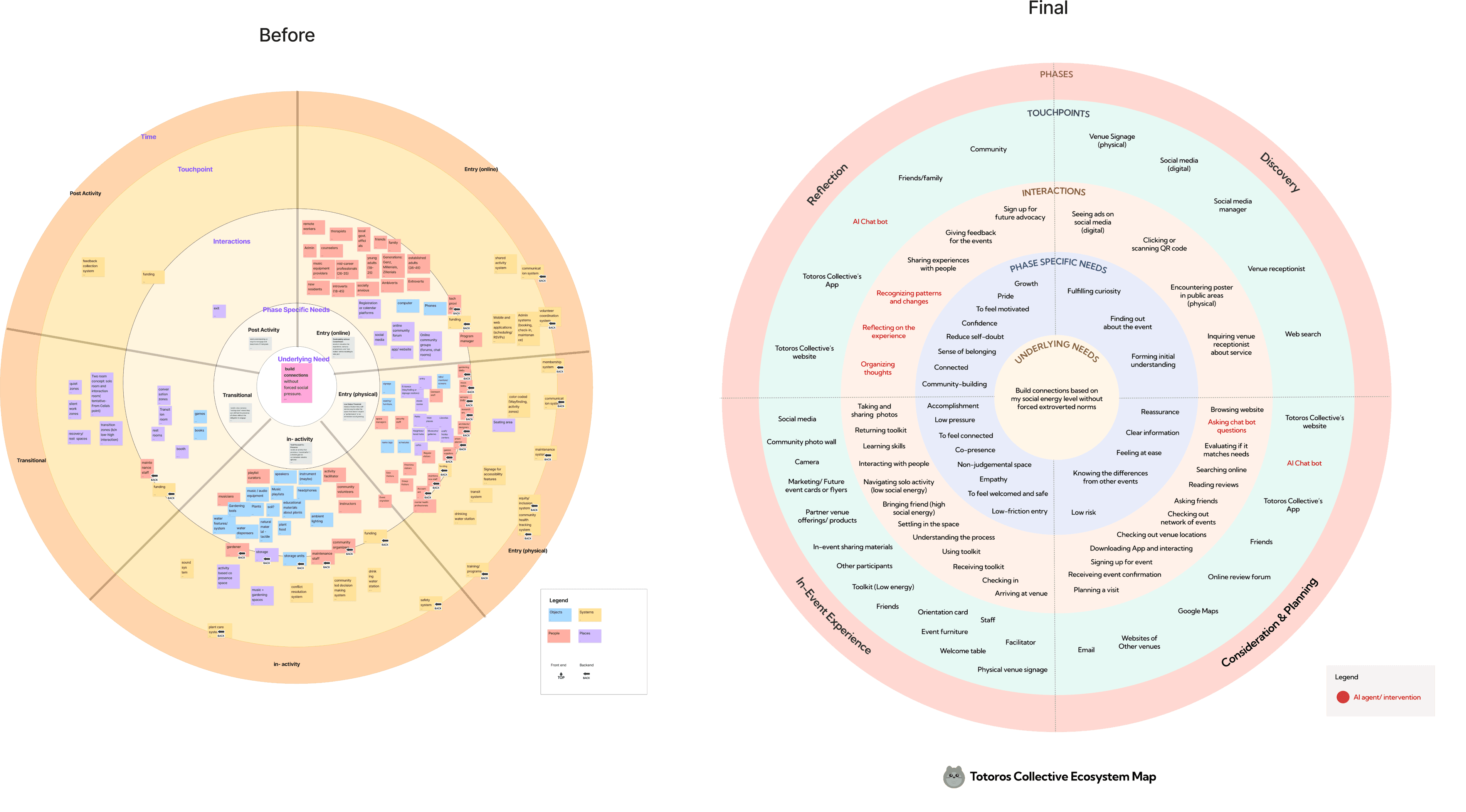
The interconnected actors, resources, and partnership flows that sustain the service ecosystem. We drafted out the messy version on the left at an early stage in research, and came back after narrative prototyping and all the other methodologies were done to finally figure it out.
ECOSYSTEM MAPPING
The interconnected actors, resources, and partnership flows that sustain the service ecosystem. We drafted out the messy version on the left at an early stage in research, and came back after narrative prototyping and all the other methodologies were done to finally figure it out.
ECOSYSTEM MAPPING
The interconnected actors, resources, and partnership flows that sustain the service ecosystem. We drafted out the messy version on the left at an early stage in research, and came back after narrative prototyping and all the other methodologies were done to finally figure it out.
USER JOURNEY MAP
Discovering the service > Considering the service > Joining the event based on their social energy >
Co-presence experience > Planning the next visit > Building a community experience > Reflect and advocate
USER JOURNEY MAP
Discovering the service > Considering the service > Joining the event based on their social energy > Co-presence experience > Planning the next visit > Building a community experience > Reflect and advocate
USER JOURNEY MAP
Discovering the service > Considering the service > Joining the event based on their social energy >
Co-presence experience > Planning the next visit > Building a community experience > Reflect and advocate

NARRATIVE PROTOTYPING (⭐️OUR HERO METHOD!)
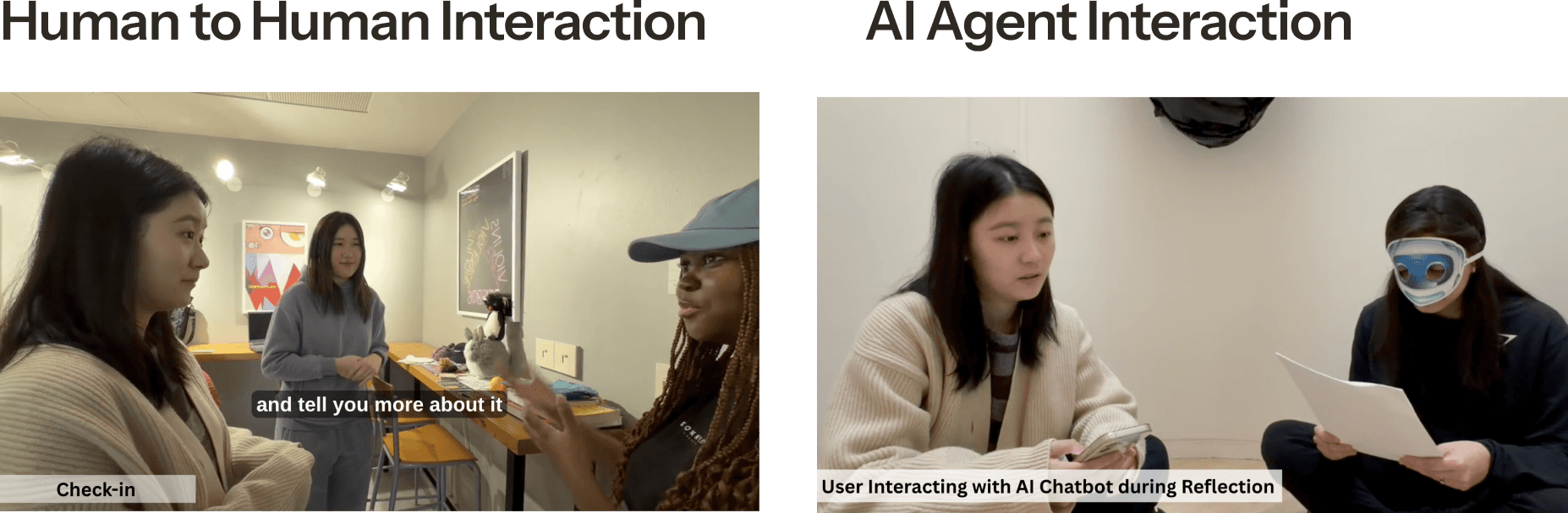
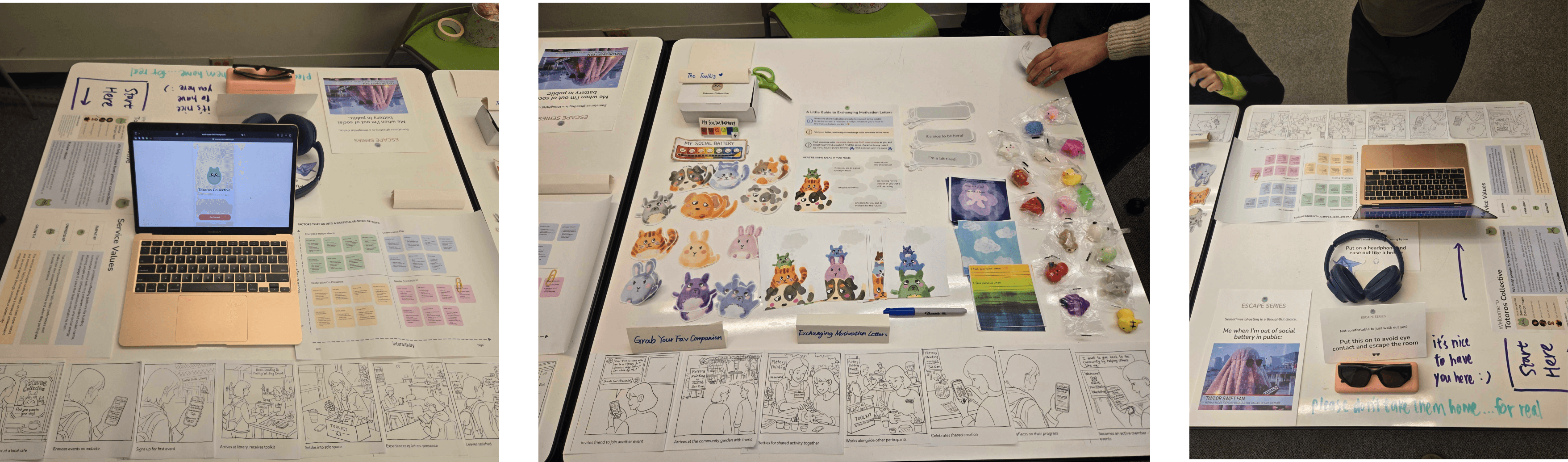
We used our journey mapping to plan out a scenario that could help us think about the interconnected interactions of individual humans, touch points, channels, and service scapes involved, and determine the roles and props we needed (The who, what, when, where, & why) then acted it out as users.
Essentially, we placed ourselves directly in the physical environment where the solution will be used, to experience the user’s real-world context firsthand.
While we had the certain scenario in mind, improvising throughout the journey really helped us truly respond with empathy and sincerity to the unfolding situation, as we experienced the reactions and logics an user may face in our solution. This method helped bridge more gaps between our research assumptions and potential design solutions, prompted us to reflect and adjust our direction.
NARRATIVE PROTOTYPING (⭐️OUR HERO METHOD!)
We used our journey mapping to plan out a scenario that could help us think about the interconnected interactions of individual humans, touch points, channels, and service scapes involved, and determine the roles and props we needed (The who, what, when, where, & why) then acted it out as users.
Essentially, we placed ourselves directly in the physical environment where the solution will be used, to experience the user’s real-world context firsthand.
While we had the certain scenario in mind, improvising throughout the journey really helped us truly respond with empathy and sincerity to the unfolding situation, as we experienced the reactions and logics an user may face in our solution. This method helped bridge more gaps between our research assumptions and potential design solutions, prompted us to reflect and adjust our direction.
NARRATIVE PROTOTYPING (⭐️OUR HERO METHOD!)
We used our journey mapping to plan out a scenario that could help us think about the interconnected interactions of individual humans, touch points, channels, and service scapes involved, and determine the roles and props we needed (The who, what, when, where, & why) then acted it out as users.
Essentially, we placed ourselves directly in the physical environment where the solution will be used, to experience the user’s real-world context firsthand.
While we had the certain scenario in mind, improvising throughout the journey really helped us truly respond with empathy and sincerity to the unfolding situation, as we experienced the reactions and logics an user may face in our solution. This method helped bridge more gaps between our research assumptions and potential design solutions, prompted us to reflect and adjust our direction.
What we learned while having fun:
Options at each step preserve user agency
AI should act as a nudge instead of directive
Sensory elements ease interactions acting as third elements between users
Movement between spaces and activities should remain flexible rather than be constrained by a strict schedule or structure
What we learned while having fun:
Options at each step preserve user agency
AI should act as a nudge instead of directive
Sensory elements ease interactions acting as third elements between users
Movement between spaces and activities should remain flexible rather than be constrained by a strict schedule or structure
What we learned while having fun:
Options at each step preserve user agency
AI should act as a nudge instead of directive
Sensory elements ease interactions acting as third elements between users
Movement between spaces and activities should remain flexible rather than be constrained by a strict schedule or structure
SERVICE BLUEPRINT
Finally, after acting out the front-stage and back-stage interaction in narrative prototyping, it allowed us to go back to truly figure out: How does the service support?
Pre-event planning & setting up
In-event experience facilitation
Post-event reflection and future advocacy process support
SERVICE BLUEPRINT
Finally, after acting out the front-stage and back-stage interaction in narrative prototyping, it allowed us to go back to truly figure out: How does the service support?
Pre-event planning & setting up
In-event experience facilitation
Post-event reflection and future advocacy process support

DESIGN QUESTION
DESIGN QUESTION
How might we design social infrastructure that supports genuine connection for introverts without forcing extroverted performance?
How might we design social infrastructure that supports genuine connection for introverts without forcing extroverted performance?
OUR VALUE STATEMENT
OUR VALUE STATEMENT
We value empathy, ownership, and growth in every connection we help foster
We value empathy, ownership, and growth in every connection we help foster
We value empathy, ownership, and growth in every connection we help foster
Translating our research insights into our core values and design, these are the main value we wanted to offer in our service, we are envisioning a future where public institutions, private venues, and community members co-evolve as an ecosystem of belonging, continuously shaped by the socio materiality of shared spaces and community:
Translating our research insights into our core values and design, these are the main value we wanted to offer in our service, we are envisioning a future where public institutions, private venues, and community members co-evolve as an ecosystem of belonging, continuously shaped by the socio materiality of shared spaces and community:
Translating our research insights into our core values and design, these are the main value we wanted to offer in our service, we are envisioning a future where public institutions, private venues, and community members co-evolve as an ecosystem of belonging, continuously shaped by the socio materiality of shared spaces and community:
Empathy
Empathy
Empathy
In a world that prizes outgoing traits, introverts may feel pressured to conform, navigating a fine line between authenticity and societal expectation.
We offer guidance that works with people’s energy, not forcing against it, helping people with different personalities and social energy levels build real connections on their own terms at a pace that feels comfortable to them, without the pressure to show up any differently than they already are.
In a world that prizes outgoing traits, introverts may feel pressured to conform, navigating a fine line between authenticity and societal expectation.
We offer guidance that works with people’s energy, not forcing against it, helping people with different personalities and social energy levels build real connections on their own terms at a pace that feels comfortable to them, without the pressure to show up any differently than they already are.
In a world that prizes outgoing traits, introverts may feel pressured to conform, navigating a fine line between authenticity and societal expectation.
We offer guidance that works with people’s energy, not forcing against it, helping people with different personalities and social energy levels build real connections on their own terms at a pace that feels comfortable to them, without the pressure to show up any differently than they already are.
Ownership
Ownership
Ownership
To support the importance of user growth and autonomy in social participation, we included scaffolded friction into our community design - allowing different forms of engagement.
We want to empower users to tailor their preferences and make their own decisions about how and when they participate in social interactions.
To support the importance of user growth and autonomy in social participation, we included scaffolded friction into our community design - allowing different forms of engagement.
We want to empower users to tailor their preferences and make their own decisions about how and when they participate in social interactions.
To support the importance of user growth and autonomy in social participation, we included scaffolded friction into our community design - allowing different forms of engagement.
We want to empower users to tailor their preferences and make their own decisions about how and when they participate in social interactions.
Growth
Growth
Growth
Encourages users to reflect on their experiences and emotions after an event, helping them develop a sense of personal achievement and growth, and begin to notice their own progress through continuous community participation.
Through a structured reflection framework, we help users shift toward a growth mindset, address self-doubt, and recognize patterns in their social comfort, making each return to the community feel more natural and less daunting than the last.
Encourages users to reflect on their experiences and emotions after an event, helping them develop a sense of personal achievement and growth, and begin to notice their own progress through continuous community participation.
Through a structured reflection framework, we help users shift toward a growth mindset, address self-doubt, and recognize patterns in their social comfort, making each return to the community feel more natural and less daunting than the last.
Encourages users to reflect on their experiences and emotions after an event, helping them develop a sense of personal achievement and growth, and begin to notice their own progress through continuous community participation.
Through a structured reflection framework, we help users shift toward a growth mindset, address self-doubt, and recognize patterns in their social comfort, making each return to the community feel more natural and less daunting than the last.
DESIGN PRINCIPLE
DESIGN PRINCIPLE
Design Requirements
Design Requirements
Design Requirements
1
Coherent setting and interactions with low cognitive load
2
Support self-oriented participation to foster agency
3
Support co-presence in shared time, space, and experience
4
Respectful of different forms of authentic human connection
THE DESIGN
THE DESIGN
We Help People Form Ongoing Genuine Connections
We Help People Form Ongoing Genuine Connections
We Help People Form Ongoing Genuine Connections
Our goal is to create a community-building service that brings people together through a network of social infrastructure, designed to accommodate varying levels of social energy and comfort. Rooted in shared community values, we partner with local venues including cafes, galleries, and libraries to host events where connection happens naturally through low-friction co-presence and hobby-based activities.
Every experience is supported by a mobile app for a easy and quick sign-up, a tailored toolkit that support the user’s social comfort during event, and a reflection support system to ensure each visit is approachable and meaningful, and is worth returning.
Our goal is to create a community-building service that brings people together through a network of social infrastructure, designed to accommodate varying levels of social energy and comfort. Rooted in shared community values, we partner with local venues including cafes, galleries, and libraries to host events where connection happens naturally through low-friction co-presence and hobby-based activities.
Every experience is supported by a mobile app for a easy and quick sign-up, a tailored toolkit that support the user’s social comfort during event, and a reflection support system to ensure each visit is approachable and meaningful, and is worth returning.
Design framework
Design framework
Design framework
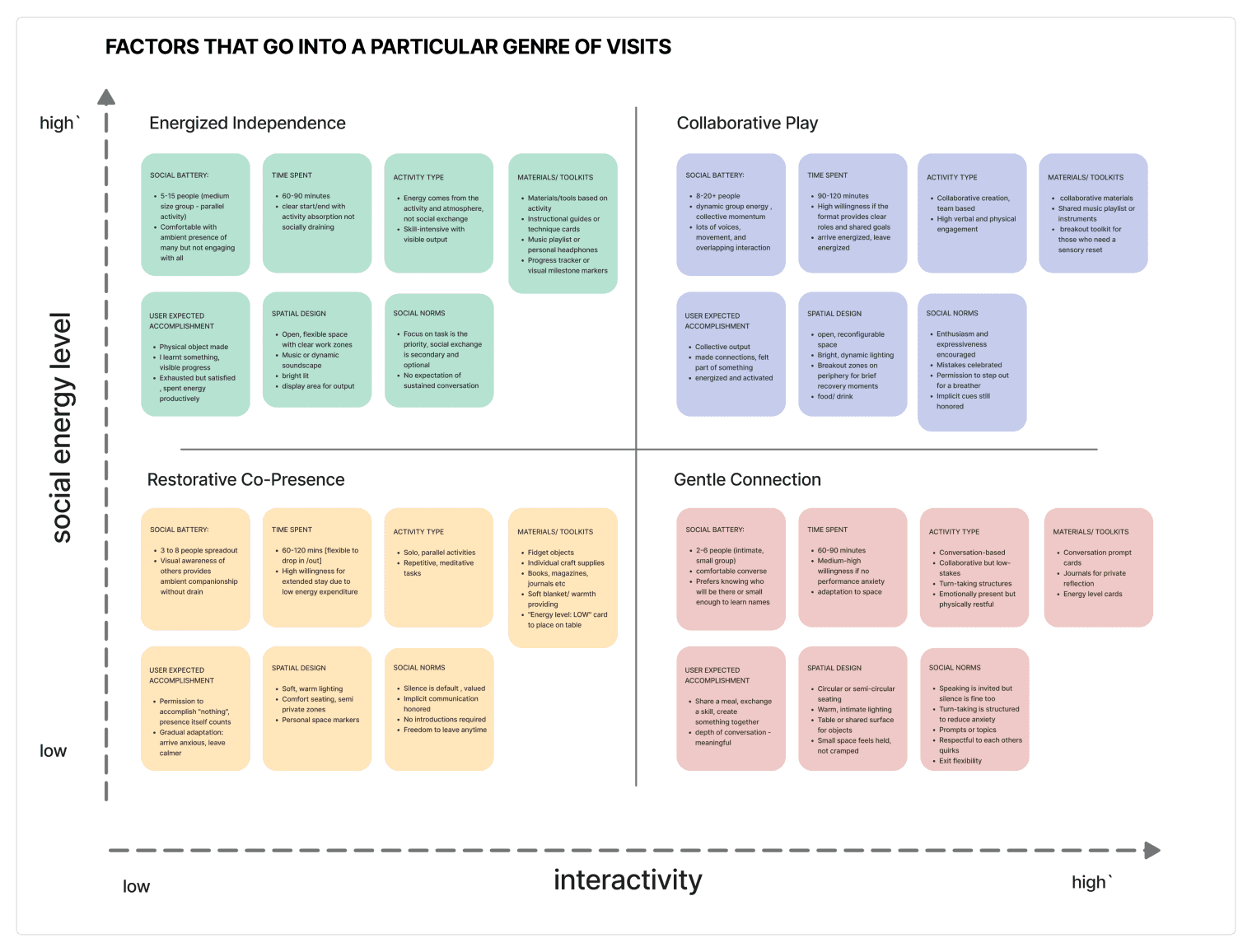
Social energy levels help us understand how much interaction and stimulation users are comfortable with during events.
We tailored these attributes into four event categories: Restorative Co-Presence, Gentle Connection, Energized Independence, and Collaborative Play
Lower energy levels focus on quiet presence or small conversations, while higher energy levels involve larger groups, collaborative activities, and dynamic engagement.
This design framework allows users to choose experiences that match their needs and participate in ways that feel comfortable and fulfilling.
Social energy levels help us understand how much interaction and stimulation users are comfortable with during events.
We tailored these attributes into four event categories: Restorative Co-Presence, Gentle Connection, Energized Independence, and Collaborative Play
Lower energy levels focus on quiet presence or small conversations, while higher energy levels involve larger groups, collaborative activities, and dynamic engagement.
This design framework allows users to choose experiences that match their needs and participate in ways that feel comfortable and fulfilling.
Social energy levels help us understand how much interaction and stimulation users are comfortable with during events.
We tailored these attributes into four event categories: Restorative Co-Presence, Gentle Connection, Energized Independence, and Collaborative Play
Lower energy levels focus on quiet presence or small conversations, while higher energy levels involve larger groups, collaborative activities, and dynamic engagement.
This design framework allows users to choose experiences that match their needs and participate in ways that feel comfortable and fulfilling.
Building a community, with the community
Building a community, with the community
Building a community, with the community
Our service partners with local venues, community organizations, and government agencies to co-create events.
We sustain the service through a $5 per-event user contribution and venue partnerships, while fostering a growth mindset where participants evolve into community advocates and co-facilitators.
With the mutual goal of fostering a community, we hope that users are comfortable giving back to the community by signing up to advocate and facilitate future events.
Our service partners with local venues, community organizations, and government agencies to co-create events.
We sustain the service through a $5 per-event user contribution and venue partnerships, while fostering a growth mindset where participants evolve into community advocates and co-facilitators.
With the mutual goal of fostering a community, we hope that users are comfortable giving back to the community by signing up to advocate and facilitate future events.
Our service partners with local venues, community organizations, and government agencies to co-create events.
We sustain the service through a $5 per-event user contribution and venue partnerships, while fostering a growth mindset where participants evolve into community advocates and co-facilitators.
With the mutual goal of fostering a community, we hope that users are comfortable giving back to the community by signing up to advocate and facilitate future events.
The app
The app
The app
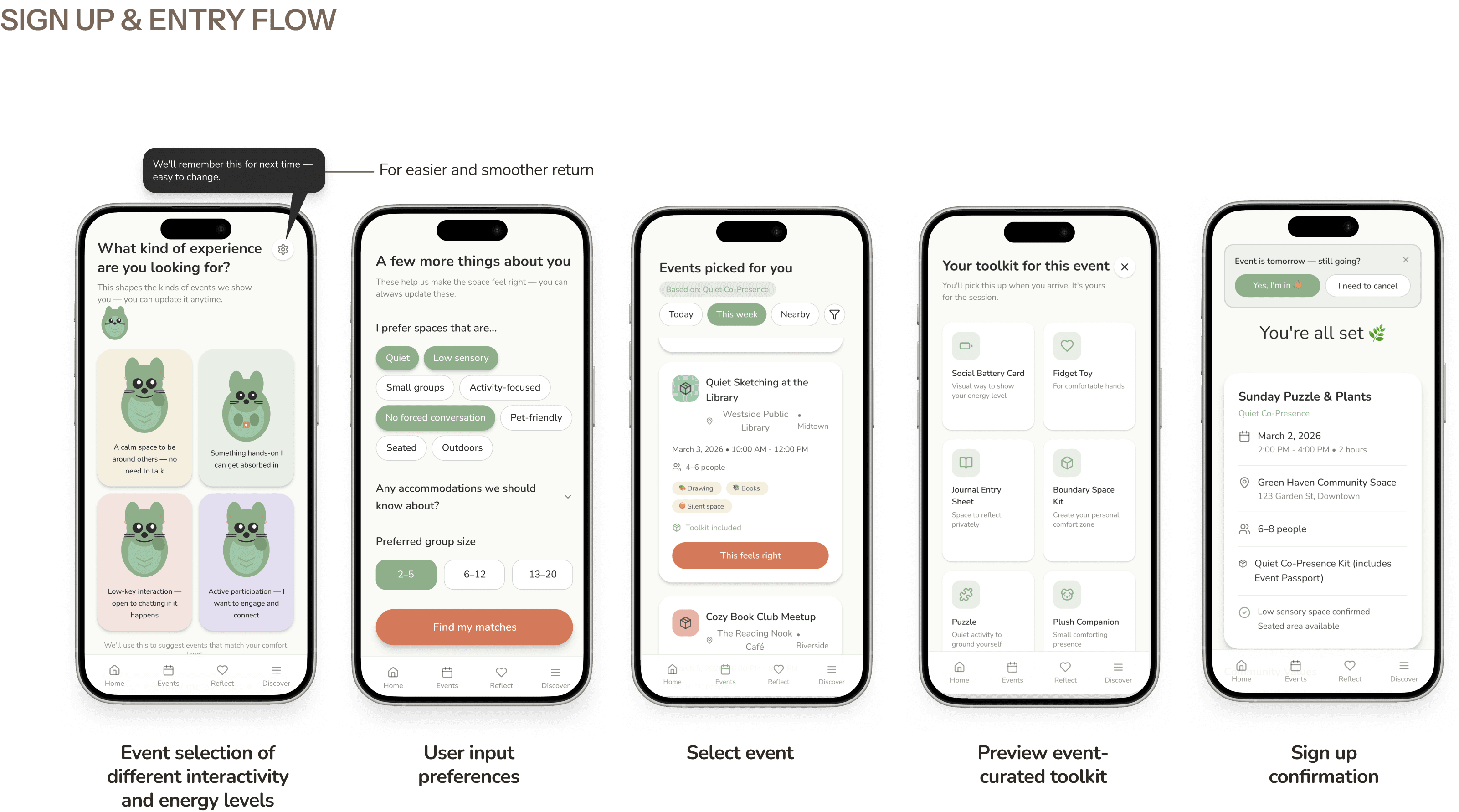
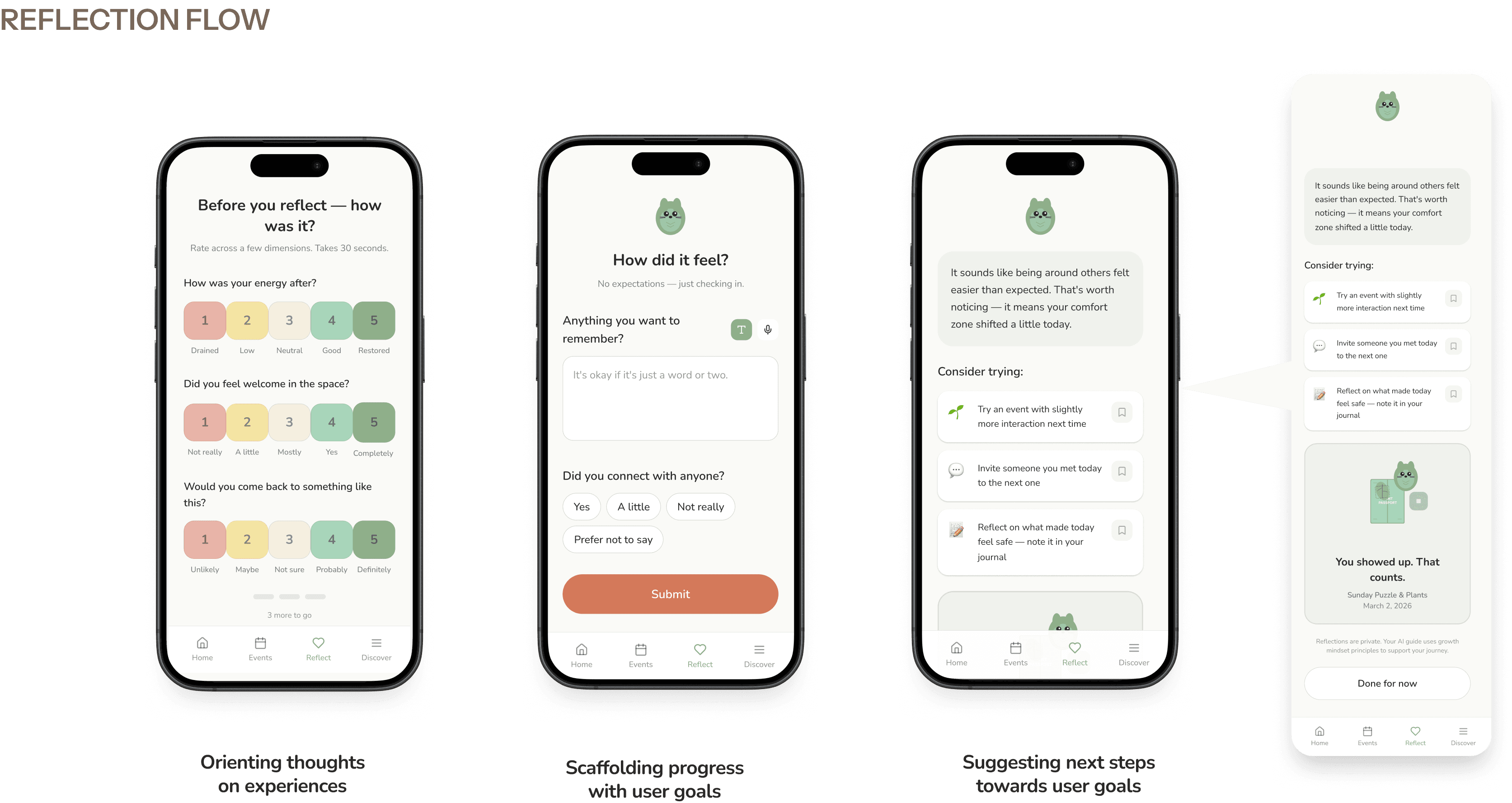
This app is used to guide users through three phases:
Pre-event preparation
Real-time support
Post-event reflection
It helps transforming events from anxiety-inducing to meaningful and achievable.
This app is used to guide users through three phases:
Pre-event preparation
Real-time support
Post-event reflection
It helps transforming events from anxiety-inducing to meaningful and achievable.
This app is used to guide users through three phases:
Pre-event preparation
Real-time support
Post-event reflection
It helps transforming events from anxiety-inducing to meaningful and achievable.
The toolkit
The toolkit
The toolkit
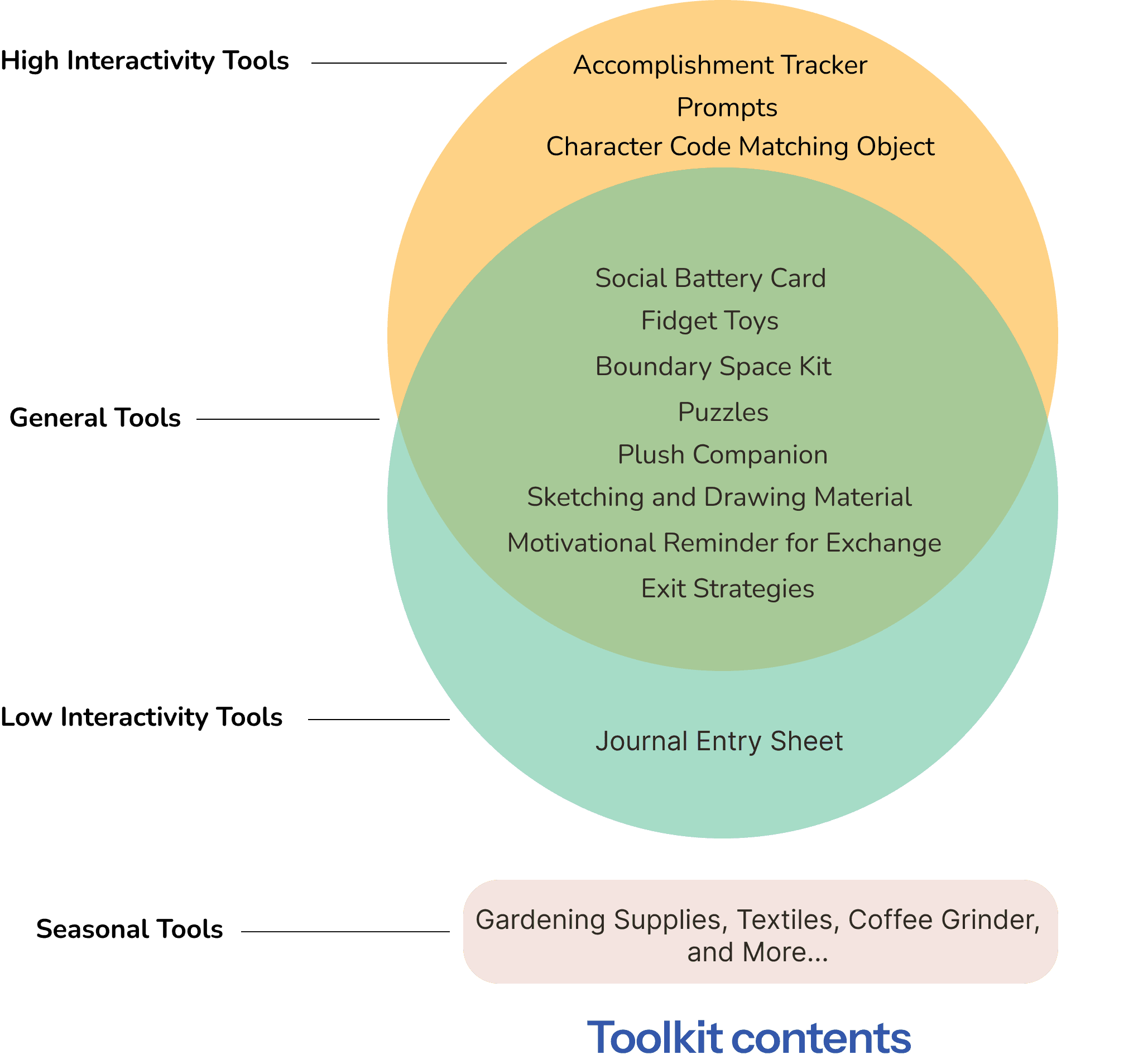
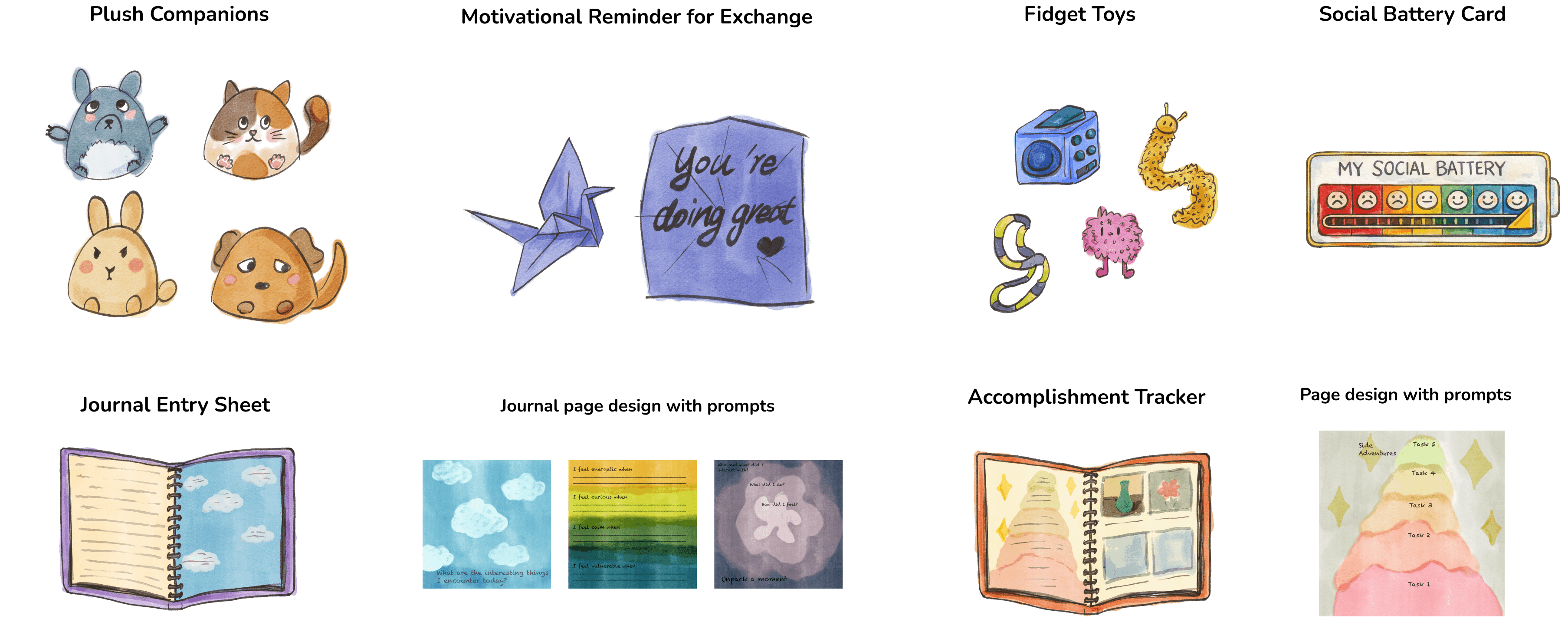
Our toolkit is a product that is given to customers upon entry into the event space.
It is supposed to help them navigate energy and interactive levels, using it as a comfort when navigating social spaces, as well as it being used in shared activities.
Our toolkit is a product that is given to customers upon entry into the event space.
It is supposed to help them navigate energy and interactive levels, using it as a comfort when navigating social spaces, as well as it being used in shared activities.
Our toolkit is a product that is given to customers upon entry into the event space.
It is supposed to help them navigate energy and interactive levels, using it as a comfort when navigating social spaces, as well as it being used in shared activities.
Inside the toolkit
Inside the toolkit
Inside the toolkit
Sketches
Sketches
Prototypes
Prototypes
My takeaway from this cool work!
My takeaway from this cool work!
My takeaway from this cool work!
Design in a bigger picture, approach design holistically for each touchpoint interactions to ease the journey for people in front/back stage could eventually end up making the customer experience better and meet the user need (how all the elements work in service just reminds me of the Domino effect)
"Seamless experience" should not always be the goal, adding thoughtful frictions that prompt customers to slow down and reflect may actually create better outcome for everyone involved and benefit the business in the long run
Break down experience into tangible and intangibel components help identify tensions, constraints, value exchange, and opportunities
I personally learned a lot that when facing ambiguity, we should try to work things the other way round, and we COULD always work in another way, reminded me of the non-linear design process and resilience. And that later prompted me to explored more possibilities and ideas when we are brainstorming and mapping out the journey, and being more comfortable with ambiguity.
Design in a bigger picture, approach design holistically for each touchpoint interactions to ease the journey for people in front/back stage could eventually end up making the customer experience better and meet the user need (how all the elements work in service just reminds me of the Domino effect)
"Seamless experience" should not always be the goal, adding thoughtful frictions that prompt customers to slow down and reflect may actually create better outcome for everyone involved and benefit the business in the long run
Break down experience into tangible and intangibel components help identify tensions, constraints, value exchange, and opportunities
I personally learned a lot that when facing ambiguity, we should try to work things the other way round, and we COULD always work in another way, reminded me of the non-linear design process and resilience. And that later prompted me to explored more possibilities and ideas when we are brainstorming and mapping out the journey, and being more comfortable with ambiguity.
Design in a bigger picture, approach design holistically for each touchpoint interactions to ease the journey for people in front/back stage could eventually end up making the customer experience better and meet the user need (how all the elements work in service just reminds me of the Domino effect)
"Seamless experience" should not always be the goal, adding thoughtful frictions that prompt customers to slow down and reflect may actually create better outcome for everyone involved and benefit the business in the long run
Break down experience into tangible and intangibel components help identify tensions, constraints, value exchange, and opportunities
I personally learned a lot that when facing ambiguity, we should try to work things the other way round, and we COULD always work in another way, reminded me of the non-linear design process and resilience. And that later prompted me to explored more possibilities and ideas when we are brainstorming and mapping out the journey, and being more comfortable with ambiguity.